

The creator economy is evolving at a breakneck pace. Today, creators are no longer just content producers—they are entrepreneurs, community builders, and brand owners.
As you look for ways to monetize your audience, one critical question inevitably arises: Should you use a dedicated creator merch platform or build a traditional ecommerce store?
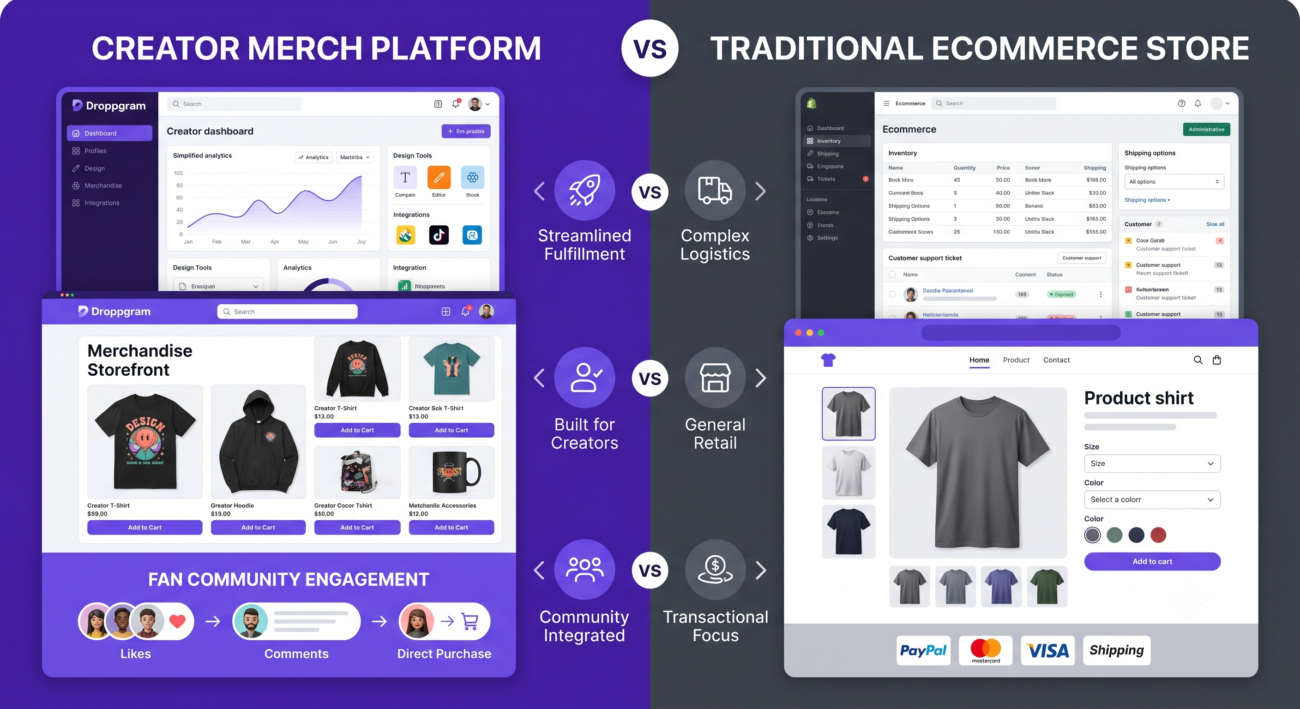
While both options allow you to sell products online, they are engineered for vastly different goals. A traditional ecommerce store focuses entirely on selling products, whereas a creator merch platform focuses on building a creator business.
Understanding this distinction is the secret to long-term financial success. In this comprehensive guide, we will break down both models to help you determine which option best fits your unique journey.
Understanding Traditional Ecommerce Stores
Traditional ecommerce platforms are built from the ground up for businesses that focus on retail operations. Familiar examples include:
- Shopify
- WooCommerce
- Magento
- BigCommerce
These platforms are highly optimized for product catalogs, inventory management, order processing, and traditional retail logistics. They work exceptionally well for established brands selling physical products at scale. However, independent creators often have fundamentally different needs.
What Is a Creator Merch Platform?
A creator merch platform is built specifically for the nuances of the creator economy. Instead of focusing solely on transactions, it seamlessly combines:
- Merchandise sales
- Fan memberships and subscription commerce
- Custom creator storefronts
- Community engagement and exclusive product drops
Here, the ultimate goal isn’t simply to move inventory—it is to build a sustainable business around an active audience.
The Core Difference: Product-First vs. Community-First
The fundamental divergence between these two models comes down to your primary business focus:
Traditional Ecommerce: Product-First. Designed to maximize individual product sales and transaction volume.
Creator Merch Platform: Community-First. Designed to maximize long-term audience value and emotional investment.
This single distinction changes how you launch products, interact with fans, and scale your income.
At-a-Glance Feature Comparison
| Feature | Traditional Ecommerce Store | Creator Merch Platform |
| Product Sales | Yes | Yes |
| Membership Revenue | No (Requires Plugins) | Yes (Built-In) |
| Fan Community Integration | Limited | Strong |
| Exclusive Drops Capabilities | Manual Setup | Built-In |
| Subscription Revenue | No (Requires Plugins) | Yes |
| Creator-Centric UX | Low | High |
Why Traditional Ecommerce Works for Retail Brands
Traditional ecommerce is the gold standard for businesses that manage massive product catalogs and heavy retail operations.
Key Advantages:
- Full Store Control: Brands can customize every pixel of the shopping experience and checkout funnel.
- Massive Scalability: Enterprise-grade architecture makes it easy to manage thousands of SKUs.
- Advanced Retail Features: Deep analytics, complex inventory tracking, and multi-channel marketplace integrations (like Amazon or eBay).
If your primary business objective is traditional retail scaling, these platforms remain an excellent choice.
Why Creator Merch Platforms Work Better for Creators
Creators operate differently than traditional retail brands. You don’t just sell physical objects; you sell identity, community, shared experiences, and relationships. A creator merch platform helps convert that organic audience engagement into predictable business growth.
1. A Fan-Centric Experience
Creators succeed because fans feel deeply connected to them. A creator merch platform strengthens this bond by offering exclusive access, premium membership benefits, and community features that traditional storefronts simply lack.
2. Predictable, Recurring Revenue
Most ecommerce stores depend entirely on one-time purchases, leaving creators trapped on a monthly revenue treadmill. Creator merch platforms natively support membership subscriptions, premium content tiers, and ongoing fan benefits, generating reliable monthly recurring revenue (MRR).
3. Frictionless Limited-Edition “Drops”
Scarcity drives modern demand. Instead of maintaining an always-on retail catalog, modern creator platforms make it incredibly easy to launch timed product drops, seasonal collections, and community-only variants.
4. Native Community Building
Communities create loyalty, and loyalty creates sustainable revenue. Merchandise works best when it serves as a badge of honor for a community. Creator merch platforms treat community building as a core feature, not an afterthought.
Creator Merch Platforms vs. Shopify: The Creator’s Dilemma
Many creators automatically look to Shopify first because of its name recognition. While Shopify is undeniably powerful, forcing it to behave like a creator ecosystem usually requires a messy web of paid third-party apps, membership plugins, and custom development.
A dedicated creator merch platform provides these tools natively out of the box, drastically reducing tech complexity and offering a much smoother experience for your fans.
Which Option Is More Profitable?
Profitability ultimately depends on your underlying monetization model.
- Traditional Ecommerce Revenue: Driven strictly by product sales, upsells, and paid advertising to acquire new customers.
- Creator Merch Platform Revenue: Diversified across merchandise, monthly fan memberships, exclusive content access, and premium community tiers.
By diversifying your income streams beyond physical items, creator platforms typically build a much stronger, more resilient long-term financial foundation.
A Tale of Two Creators
Imagine two creators, both with an audience of 100,000 followers:
- Creator A (Traditional Ecommerce Store): Relies solely on occasional shirt sales. Revenue spikes during a launch but drops to zero shortly after.
- Creator B (Creator Merch Platform): Sells the same shirt, but also offers a $5/month VIP fan membership for exclusive content and early access to drops.
Over time, Creator B builds a highly predictable, scalable business, while Creator A remains vulnerable to algorithm changes.
Common Mistakes Creators Make
- Choosing Based Only on Initial Cost: The cheapest software solution can cost you thousands in lost features and complex setups down the road.
- Thinking Like a Retailer: You are a community leader, not a retail warehouse manager. Focus on connection over inventory volume.
- Ignoring Recurring Revenue: Relying only on one-off merch sales leaves massive amounts of money on the table.
The Future of Creator Commerce
The creator economy is shifting rapidly toward true digital ownership, deep community roots, and direct audience relationships. The future isn’t about figuring out how to sell more generic products; it’s about building a dedicated ecosystem where your top fans can support you sustainably.
Why More Creators Are Choosing Droppgram
Droppgram was engineered specifically for the modern creator business. Instead of acting like a rigid, sterile online store, Droppgram seamlessly fuses creator storefronts, fan memberships, subscription commerce, and exclusive product drops into one powerful dashboard. It turns casual followers into lifelong supporters.
Frequently Asked Questions
What is the main difference between a creator merch platform and an ecommerce store?
A creator merch platform natively integrates merchandise, fan memberships, and community features to monetize an audience. A traditional ecommerce store focuses strictly on product sales and retail logistics.
Is Shopify good for creators?
Shopify is an excellent tool, but it requires multiple paid apps and custom integrations to handle the community memberships and recurring revenue features that creators need.
Why do creators need membership models?
Memberships provide predictable monthly recurring revenue (MRR), making your creative business financially stable and less dependent on platform algorithms.
What is the best platform for creators?
The best platform is one that consolidates merchandise, subscriptions, and community tools into a single ecosystem, allowing you to focus on content rather than managing software.
Conclusion: Ready to Build More Than a Store?
Traditional ecommerce stores are fantastic tools for product-focused retail brands. But if your goal is to nurture a loyal audience, unlock recurring membership revenue, and build a lasting business, a creator merch platform is the clear winner.
Don’t just open a shop build a community.
